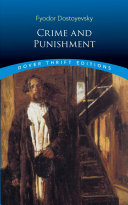
Crime and Punishment
Credits and rights
- Original writer
- Fyodor Dostoyevsky
- Publisher of this edition
- BoingyBooks Classics
- Original publisher
- Project Gutenberg
- Adaptation credits
- John Shoufler / BoingyBooks Classics — digital edition
- Original source / edition
- Crime and Punishment (1866)
- License
- Public Domain
- Rights and adaptation notice
- This work is in the public domain. John Shoufler published this digital edition through BoingyBooks Classics. The original work remains public domain and may be copied, adapted, and shared.
Crime and Punishment by Fyodor Dostoyevsky (1866)
A destitute student murders a pawnbroker, believing himself to be an extraordinary man above moral law. What follows is one of literature's most intense psychological explorations of guilt, conscience, and redemption.
Historical Significance:
Dostoyevsky wrote Crime and Punishment while in severe financial distress, having lost his savings gambling in Wiesbaden. He serialized it in The Russian Messenger from January to December 1866. He was simultaneously writing another novel, The Gambler, to meet a crushing deadline — he dictated it to a young stenographer, Anna Snitkina, whom he married four months later.
The novel was partly inspired by the case of Pierre-François Lacenaire, a French murderer who justified his crimes through intellectual philosophy. Dostoyevsky, who had himself been sentenced to death (commuted at the last moment to hard labor in Siberia), understood the psychology of extreme situations better than perhaps any other novelist.
Raskolnikov's theory — that extraordinary people like Napoleon are above conventional morality — was Dostoyevsky's critique of the nihilism and utilitarianism spreading through Russian intellectual circles in the 1860s.
Cultural Impact:
Crime and Punishment is considered one of the greatest novels ever written and the founding text of psychological fiction. It influenced Nietzsche, Freud, Kafka, Camus, and virtually every crime novelist who followed. The "Raskolnikov complex" — intellectual justification for immoral acts — remains a concept in psychology and philosophy. The novel is required reading in universities worldwide.
This public domain classic was originally published in 1866. Free to read and share.
Read the first chapter free — experience the full reader
Create a free account to read this book and 232+ more classics
What's Included
- Reflowable text that adapts to any screen
- Adjustable font size with pinch-to-zoom
- Light, Sepia, and Dark reading themes
- Serif/sans-serif font toggle
- Chapter navigation with swipe & keyboard
- Highlight text in 4 colors
- Add notes to highlighted passages
- Text-to-speech — listen to any chapter
- Remembers your reading position
- Download the complete edition for reading offline
- Works on all devices