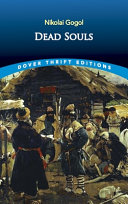
Dead Souls
Credits and rights
- Original writer
- Nikolai Gogol
- Publisher of this edition
- BoingyBooks Classics
- Original publisher
- Project Gutenberg
- Adaptation credits
- John Shoufler / BoingyBooks Classics — digital edition
- Original source / edition
- Dead Souls (1842)
- License
- Public Domain
- Rights and adaptation notice
- This work is in the public domain. John Shoufler published this digital edition through BoingyBooks Classics. The original work remains public domain and may be copied, adapted, and shared.
Dead Souls by Nikolai Gogol (1842)
Chichikov, a charming con man, travels through provincial Russia buying "dead souls" — serfs who have died but still appear on the census rolls — as collateral for a fraudulent mortgage scheme. Russia's greatest satirical novel.
Historical Significance:
Gogol published Part One of Dead Souls in 1842, intending a three-part work modeled on Dante's Divine Comedy: Part One as Inferno (Russia's corruption), Part Two as Purgatorio (moral awakening), and Part Three as Paradiso (redemption). He burned the manuscript of Part Two shortly before his death in 1852, believing it was not worthy. Part One alone — a panorama of provincial Russian absurdity — is considered a masterpiece. Every character Chichikov meets embodies a different human vice: miserliness, gluttony, sentimentality, brutality. Nabokov called it "the greatest Russian novel." It influenced Dostoyevsky, Bulgakov, and every subsequent Russian satirist.
This public domain classic was originally published in 1842. Free to read and share.
Read the first chapter free — experience the full reader
Create a free account to read this book and 232+ more classics
What's Included
- Reflowable text that adapts to any screen
- Adjustable font size with pinch-to-zoom
- Light, Sepia, and Dark reading themes
- Serif/sans-serif font toggle
- Chapter navigation with swipe & keyboard
- Highlight text in 4 colors
- Add notes to highlighted passages
- Text-to-speech — listen to any chapter
- Remembers your reading position
- Download the complete edition for reading offline
- Works on all devices