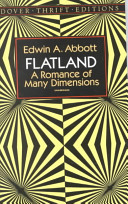
Flatland: A Romance of Many Dimensions
Credits and rights
- Original writer
- Edwin A. Abbott
- Publisher of this edition
- BoingyBooks Classics
- Original publisher
- Project Gutenberg
- Adaptation credits
- John Shoufler / BoingyBooks Classics — digital edition
- Original source / edition
- Flatland: A Romance of Many Dimensions (1884)
- License
- Public Domain
- Rights and adaptation notice
- This work is in the public domain. John Shoufler published this digital edition through BoingyBooks Classics. The original work remains public domain and may be copied, adapted, and shared.
Flatland: A Romance of Many Dimensions by Edwin A. Abbott (1884)
A square living in a two-dimensional world is visited by a sphere from the third dimension, shattering everything he thought he knew about reality. A mathematical satire that is also a sharp social commentary on Victorian class and gender hierarchies.
Historical Significance:
Edwin Abbott Abbott, a schoolmaster and theologian, published Flatland in 1884 under the pseudonym "A Square." The novella uses dimensional analogy to explain higher mathematics: just as a two-dimensional being cannot comprehend three dimensions, perhaps we three-dimensional beings cannot perceive the fourth dimension. The book was largely forgotten until physicists and mathematicians rediscovered it in the 20th century.
Flatland is now beloved by STEM readers, taught in mathematics and physics courses worldwide, and cited in discussions of string theory and extra dimensions. Carl Sagan devoted a segment of his Cosmos TV series to explaining Flatland. It is also a cutting satire of Victorian social rigidity — women are mere lines, the working class are triangles, and priests are circles.
This public domain classic was originally published in 1884. Free to read and share.
Read the first chapter free — experience the full reader
Create a free account to read this book and 232+ more classics
What's Included
- Reflowable text that adapts to any screen
- Adjustable font size with pinch-to-zoom
- Light, Sepia, and Dark reading themes
- Serif/sans-serif font toggle
- Chapter navigation with swipe & keyboard
- Highlight text in 4 colors
- Add notes to highlighted passages
- Text-to-speech — listen to any chapter
- Remembers your reading position
- Download the complete edition for reading offline
- Works on all devices