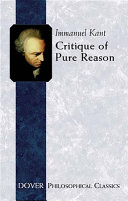
The Critique of Pure Reason
Credits and rights
- Original writer
- Immanuel Kant
- Publisher of this edition
- BoingyBooks Classics
- Original publisher
- Project Gutenberg
- Adaptation credits
- John Shoufler / BoingyBooks Classics — digital edition
- Original source / edition
- The Critique of Pure Reason (1781)
- License
- Public Domain
- Rights and adaptation notice
- This work is in the public domain. John Shoufler published this digital edition through BoingyBooks Classics. The original work remains public domain and may be copied, adapted, and shared.
The Critique of Pure Reason by Immanuel Kant (1781)
The most important work of modern philosophy. Kant asks: what can we know? His answer — that the mind actively structures experience rather than passively receiving it — revolutionized every branch of human knowledge.
Historical Significance:
Immanuel Kant, a professor in Königsberg, Prussia, who famously never traveled more than 10 miles from his birthplace, published the Critique of Pure Reason in 1781 after a decade of intensive work. The book is notoriously difficult — Kant himself called it "dry, obscure, contrary to all ordinary ideas, and on top of that prolix" — but its conclusions transformed philosophy, science, and culture. Kant demonstrated that space, time, and causality are not features of the world itself but structures imposed by the human mind. This "Copernican revolution in philosophy" influenced everything from Einstein's relativity to cognitive science to postmodern theory.
This public domain classic was originally published in 1781. Free to read and share.
Read the first chapter free — experience the full reader
Create a free account to read this book and 232+ more classics
What's Included
- Reflowable text that adapts to any screen
- Adjustable font size with pinch-to-zoom
- Light, Sepia, and Dark reading themes
- Serif/sans-serif font toggle
- Chapter navigation with swipe & keyboard
- Highlight text in 4 colors
- Add notes to highlighted passages
- Text-to-speech — listen to any chapter
- Remembers your reading position
- Download the complete edition for reading offline
- Works on all devices