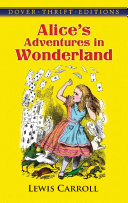
Alice's Adventures in Wonderland
Credits and rights
- Original writer
- Lewis Carroll
- Publisher of this edition
- BoingyBooks Classics
- Original publisher
- Project Gutenberg
- Adaptation credits
- John Shoufler / BoingyBooks Classics — digital edition
- Original source / edition
- Alice's Adventures in Wonderland (1865)
- License
- Public Domain
- Rights and adaptation notice
- This work is in the public domain. John Shoufler published this digital edition through BoingyBooks Classics. The original work remains public domain and may be copied, adapted, and shared.
Alice's Adventures in Wonderland by Lewis Carroll (1865)
One of the most beloved and influential children's books ever written, Alice's Adventures in Wonderland began as a story told by Charles Lutwidge Dodgson (pen name Lewis Carroll) to Alice Liddell and her sisters during a boat trip on the Thames on July 4, 1862.
Historical Significance:
Carroll, a mathematics lecturer at Christ Church, Oxford, wrote the story down at Alice Liddell's request and presented her with a handwritten manuscript titled "Alice's Adventures Under Ground" in November 1864. Encouraged by friends including George MacDonald (whose children loved the story), Carroll expanded and published it with John Tenniel's iconic illustrations in 1865.
The book broke every rule of Victorian children's literature. Where other children's books were moralistic and instructional, Alice was pure nonsense — playful, subversive, and wildly imaginative. The Cheshire Cat, the Mad Hatter's Tea Party, the Queen of Hearts — Carroll created characters that have become permanent fixtures of world culture.
Carroll was also a pioneering photographer, logician, and mathematician. Many scholars believe the book's wordplay and logic puzzles reflect his mathematical mind, with hidden references to non-Euclidean geometry and abstract algebra.
Cultural Impact:
Alice has been translated into at least 174 languages (more than any other novel). It has inspired Disney's animated classic (1951), Tim Burton's films, video games, fashion, art, and an entire literary genre of "nonsense literature." The phrase "down the rabbit hole" has entered everyday English. Scientists have named mathematical concepts, psychological conditions (Alice in Wonderland syndrome), and even a quantum physics phenomenon after the book.
This public domain classic was originally published in 1865. Free to read and share.
Read the first chapter free — experience the full reader
Create a free account to read this book and 232+ more classics
What's Included
- Reflowable text that adapts to any screen
- Adjustable font size with pinch-to-zoom
- Light, Sepia, and Dark reading themes
- Serif/sans-serif font toggle
- Chapter navigation with swipe & keyboard
- Highlight text in 4 colors
- Add notes to highlighted passages
- Text-to-speech — listen to any chapter
- Remembers your reading position
- Download the complete edition for reading offline
- Works on all devices